Welcoming Little Amal to Boston!

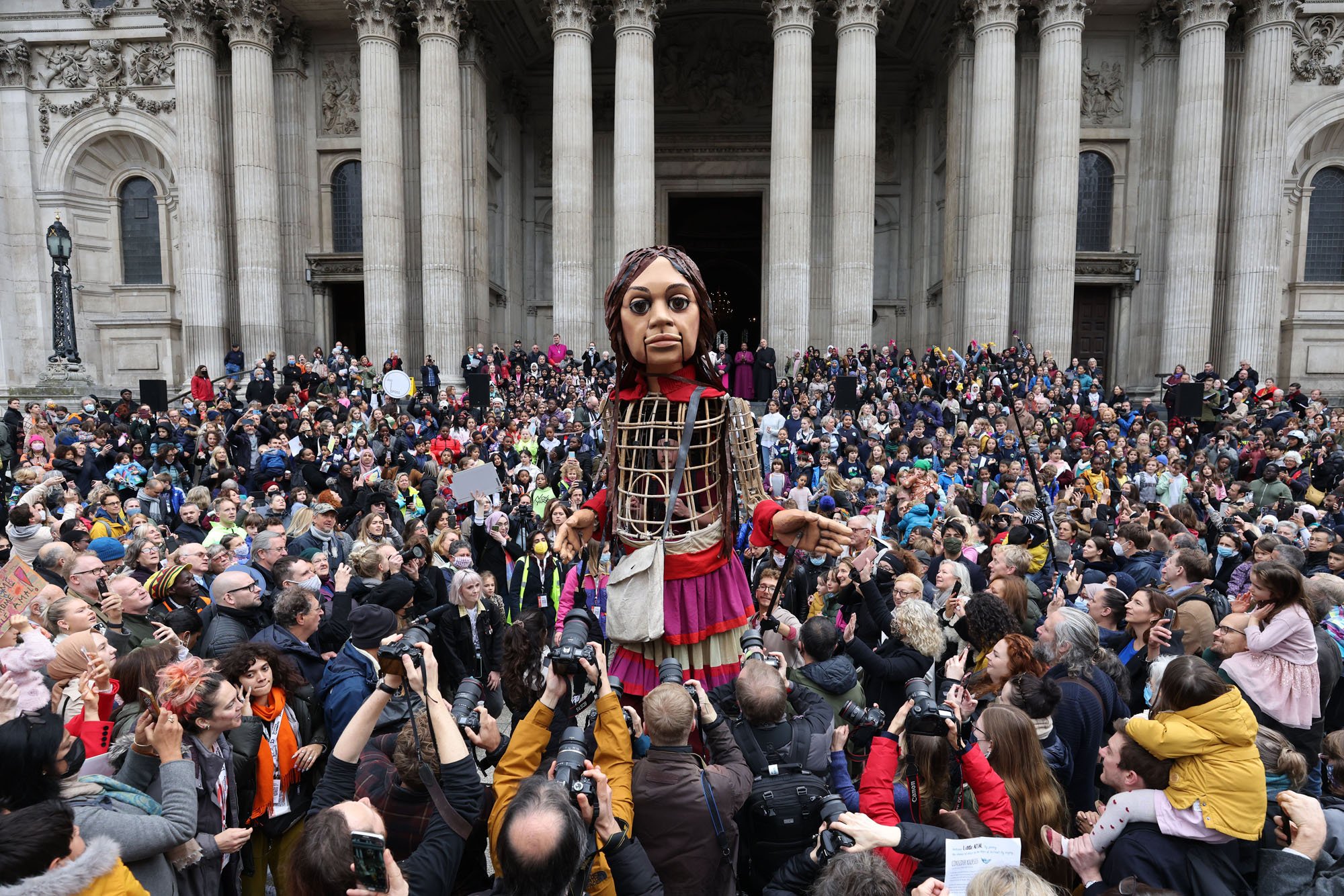
Meet Little Amal, a 12 foot tall puppet of a 10 year old Syrian refugee. Here, she is welcomed in London in 2021 after completing a 5,000 mile journey across Europe. I’m excited to welcome her to my hometown in a week!

by Brigid Rowlings, LHI Communications Director

Little Amal, whose name means “hope” in Arabic, is a 12 foot tall puppet of a 10 year old Syrian refugee girl. She was created by Handspring Puppet Company to bring hope to refugees and displaced people around the world, especially children separated from their parents. She has traveled to more than 97 towns and cities in 15 countries and been welcomed by more than a million people. Her urgent message to us all is “Don’t forget about us.”

When I learned that Little Amal was coming to the United States, and was starting her journey right here in Boston, I wanted to find out how to be a part of welcoming her. I learned that the American Repertory Theater (A.R.T.) is a partner of Amal Walks Across America and is holding a series of workshops for the community to prepare for Amal’s arrival. Intrigued, I signed up for a session.


Yuna is excited to welcome Little Amal with an assortment of Amal’s favorite food: cookies!


I arrived at the Harvard Ed Portal, a space for collaboration between Harvard University and the communities that surround it. I quickly met Yuna, age 4, and her sister Mina, age 2, who were there with their parents. Yuna had been reading books about refugees which is how she learned about Little Amal. Both girls were excited to tell the group that they’d seen a video of Little Amal’s appearance on the daytime TV program The View.

While Brisa Areli Muñoz, who is directing the Little Amal project for the A.R.T., led us through a poetry exercise, Yuna and Mila worked with Donya, a teaching artist at the A.R.T, to create posters to welcome Little Amal. What did the girls draw? Cookies! They’d learned from The View that cookies are Little Amal’s favorite food.

I was surprised and excited to find out that part of our role at the workshop that day was to think about what might happen when Little Amal approaches the gates to Harvard Yard. If you haven’t seen these gates in person or in photographs, they are a series of elaborate wrought iron gates spaced throughout a brick wall that surrounds Harvard Yard

Brisa led our group through a conversation about what Little Amal’s approach to these gates might look like. We talked about the gates as a symbol for barriers—not only to Little Amal, but to many people who may not be able to access education, never mind the elite education of an Ivy League college. Emma, an A.R.T. student intern, shared that at night, the gates are locked and students must show their college ID to enter Harvard Yard. This led us to think about the importance of IDs and documents when crossing borders, and that some refugees and displaced people may not have had time to gather those items before fleeing their homes.


Ken, Emma, and Yolanda workshop a scene depicting Little Amal’s arrival at the gates of Harvard Yard. Thank you to the chairs for playing the role of the gate!


Then, Emma, Yolanda, a recent graduate of the Harvard Graduate School of Design, Ken, a fellow community member, and I were tasked with coming up with possible ways Little Amal might interact with the gates to Harvard Yard. My group wanted the experience to communicate some truths about what refugees might experience. We came up with a scenario where Little Amal is turned away because she does not have an ID and can only enter when a person in power intervenes. A riff on this idea was one where two students collaborate to distract the security guard so that the ID-less Amal can sneak in.

My favorite idea, however, is that Little Amal sees a book floating through the Yard on the other side of the gates. She enters through the gates following the promises the book holds. 

I think this is my favorite scenario because although my work at LHI has taught me so much about the challenges facing refugees and displaced people, it has also taught me through our library and education programs in Greece, our classroom program in Jordan, and our Storytime Project in Moldova, that stories, books, and learning offer hope and bring joy. 

So, while I don’t know which direction Brisa and her team will take, I hope it is the magic book. I am excited to find out as I continue to participate in this project and welcome Little Amal on September 7!

To find out more about Lifting Hands International’s work with refugees and displaced people here in the United States and around the world, and how you can help us in this work, click here!
Visiting LHI Projects in Ukraine and Jordan Made a Lifetime of Difference to Me

By Mary Carriero, Chairperson, LHI Board of Directors

LHI Board of Directors Chairperson, Mary Carriero (center in sunglasses), traveled with members of the LHI crew to Jordan and Ukraine to check in on our operations there.

It was a genuine privilege to accompany Hayley Smith, LHI Founder and Director, and Walker Frahm, LHI COO, on a recent trip to visit LHI’s programs in Jordan and Ukraine. In both countries, the needs LHI is addressing are visible, raw and immediate.

While in Jordan, Mary (pictured in a pink hat) helped inspect each goat to be distributed.

On our first stop, Jordan, I immediately saw how desperately the goats we distribute are needed by Syrian refugee families. Goats are in such demand because owning goats so significantly improves quality of life for Syrian refugees in Jordan. In tents and homes, we were offered milk, yogurt and cheese that had all come from the goats. A family spoke of saving the money they earned from selling goat dairy products to pay for surgery needed for their young son’s eye. These are refugee families that have lived in camps for 10+ years. For them, goats are part of a path to a better, sustainable future.

When we arrived in Ukraine, I reflected that appearances can be deceiving. On the surface, Lviv resembles any number of other beautiful, old European cities. But a few weeks before we visited, Lviv was directly attacked by Russian shelling. When we checked into our hotel, we were told the hours for breakfast, the location of the hotel restaurant—and the location of the hotel bomb shelter.

Ongoing attacks force ordinary Ukrainians to make tough choices. Hayley and I were with one of our partners as she dropped her daughter off to stay with family outside of Lviv—she considered it safer than having her daughter with her in the city. Another partner, whose wife had recently given birth, spoke of women in labor at the local hospital needing to be moved to the basement for safety during the attack—and that is where some women gave birth. And, on our bus out of Ukraine to Poland, we sat behind a young mother and her two young children, all in tears as they said goodbye to their father. He, like most Ukrainian men between the ages of 18 and 60, cannot legally leave the country because of a general mobilization order.

Mary (left) visited the LHI Women’s Shelter in Ukraine with LHI Founder and Director Hayley Smith and LHI COO Walker Frahm.

The psychological and physical impact of the ongoing war across the whole of Ukraine’s population is enormous. But LHI is making a real difference in the lives of Ukrainians via services such as food distribution to internally displaced persons (IDPs), psychological support programs, and a shelter providing housing for those needing assistance.

One consistent element in both Jordan and Ukraine was the complete commitment, dedication, and generosity of our local teams. As I met with members of these groups in person, I saw first-hand the strengths of LHI’s model of utilizing locals to get the work done. Each team is intimately familiar with, and personally involved in, assessing needs and providing aid. Our local teams work creatively, collaboratively, and tirelessly to provide solutions that are tailored to these needs, emphasizing stability and sustainability. On a personal level, each group went out of their way to welcome our team with meals, fellowship and smiles.

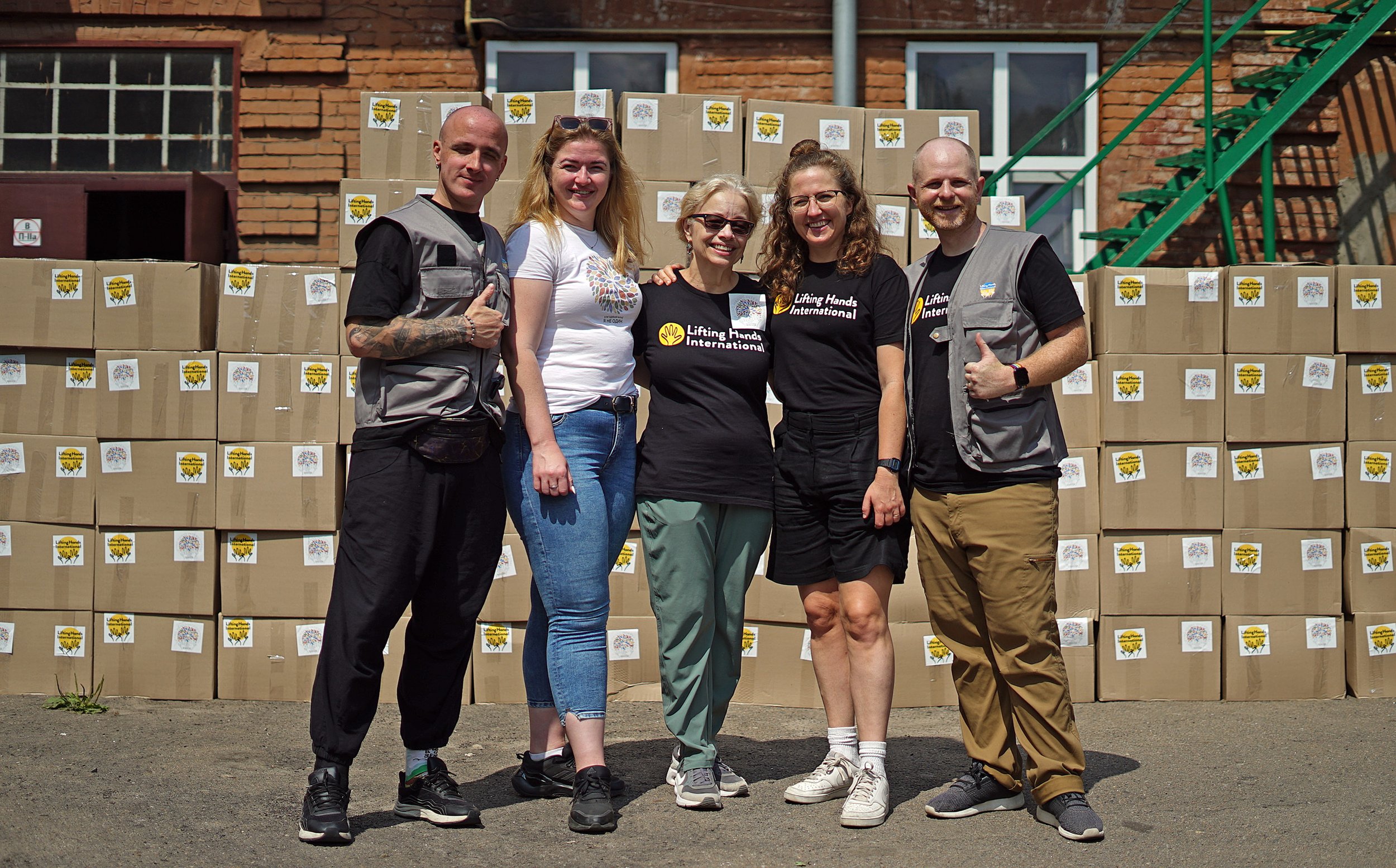
Mary helped prepare food boxes for distribution to displaced families in Ukraine.

I can’t close this note without touching on the laughter and communion that provide moments of joy throughout this trip. Whether it was sharing underground dining, a theme that ran throughout the trip (we ate in a cave, a WWII bunker and the basement shelter), or the many hours spent in a bus twilight zone (if you know, you know), or desperately seeking 30 Polish groszy (to be able to use the bathroom in the aforementioned twilight zone), this was a group of people who were able to find the humor in everything. When the situations you are witnessing can be so intense, laughter becomes a true gift.

Mary (left) shares a meal with LHI Founder and Director Hayley (2nd from left) and the rest of the LHI crew at the LHI Women’s Shelter in Ukraine.

This trip made a lifetime of difference to me. The key takeaway I came home with is how directly impactful LHI’s work is. I don’t think anyone can have this experience without coming away with a tremendous sense of pride in all that the entire LHI team is doing and has accomplished.

Thank you LHI!

Field Journal: Summer in Basarabeasca, Moldova Part II

by LHI Volunteers Davide and Thomas

Davide and Thomas started week two by introducing the book Stuck by Oliver Jeffers to the campers.

If you missed Part I, check it out here.

Two of our amazing international volunteers, Thomas from the UK and Davide from Italy, have been spending their summer volunteering at an LHI-sponsored community center in Basarabeasca, Moldova. We are excited to share Thomas and Davide’s travel journal, starting from week 2!

July 31st 2023, Monday, Basarabesca, Moldova

LHI volunteers – second week report

The second week in Basarabeasca marked the beginning of our leading our own activities within the community center. We decided to focus on the group of children participating in the daily summer camp, and thought it would be helpful to build most of our activities around a story.

We started with reading a very short picture book to the group, reading in English while providing a Russian translation. The story, Stuck by Oliver Jeffers, is about a little boy that gets his kite stuck in a tree, and, in trying to get it back, throws into the same tree a long list of objects, from the most ordinary to the most absurd. From here, we led several activities, all aimed at both helping the children learn English and having lots of fun at the same time! We made flashcards with vocabulary from the story, learned to make our own kites, drew the tree from the story and along with all the objects the kids would choose to throw at it. All along, we tried to constantly practice the vocabulary from the story.

The campers were excited to try out the kites they made using the story Stuck as inspiration!

The results were extremely positive: kids participated with interest, had fun, and played together while learning some English. On one of the last days of the week, Sonia, a girl from Ukraine, even created her own game, using ours as an inspiration. Our original flashcards had drawings, English vocabulary words, and their translation in Russian. Sonia took this idea a step further, making cards in Ukrainian and Russian to play with us and the other children.

Campers created their own version of the tree in stuck and had a great time deciding what they would throw into the tree.

At the end of the second week, relationships with the staff of the center were also very positive. Day after day, they started to trust us more and give us more responsibility, both inviting us to participate in their activities and giving us the space to implement ours. At the end of the week, for instance, they asked us to organize the outside sport morning activities for the day. 

The town of Basarabeasca has been very welcoming. People ask us what we are doing here, and they are glad to know we are volunteers. Even if it has been just two weeks, we already feel that we are having an impact on the community.

Click here to learn more about our programs in Moldova.

Field Journal: Summer in Basarabeasca, Moldova Part I

by LHI Volunteers Davide and Thomas


Thomas has volunteered at our center in Greece multiple times. So cool he’s in Moldova now!


Two of our amazing international volunteers, Thomas from the UK and Davide from Italy, have been spending their summer volunteering at an LHI-sponsored community center in Basarabeasca, Moldova. We are excited to share Thomas and Davide’s travel journal, starting from day 1!

July 24th 2023, Basarabesca, Moldova

LHI volunteers – first week report

One week ago we arrived in Basarabeasca, a small town in the south-east of Moldova. It is here where we will be volunteering for the following five or six weeks. On Monday evening we reached the city and went directly to our accommodation: a former dormitory for railway workers and students located only 500 meters from the Ukrainian border. We are sharing the space with a few refugees from Ukraine. We learned that Basarabesca was—and partially still is—an important center for rail transport. 

The Phoenix Center—the local community center in which we are volunteering—is a precious resource for the city. It offers recreational activities, seminars, courses, free access to a gym and much more. We met the director of the center, Ms. Klara, the same evening we arrived in Basarabeasca. She was waiting for us on the side of the road not very far from her house. We stopped the car, and had our first meeting right on the spot, communicating in French, using some Russian, English, or Italian words when we could not understand each other. 

At the end of our first day, the mayor of Basarabesca came to the center just to meet us! Just like Klara, he was glad that we’d come to the Phoenix Center. He was enthusiastic and ready to help with anything we might need. 

Day 2: The children arrived around 9 am and were soon busy playing table tennis, using the computers in the computer room, making bracelets or necklaces, or practicing some of their favourite dances. Once everyone was assembled, we headed outside with Maxim, who runs the gym, for outdoor games and activities.

The summer campers at the Phoenix Center made sure that Davide and Thomas felt very welcomed and included!

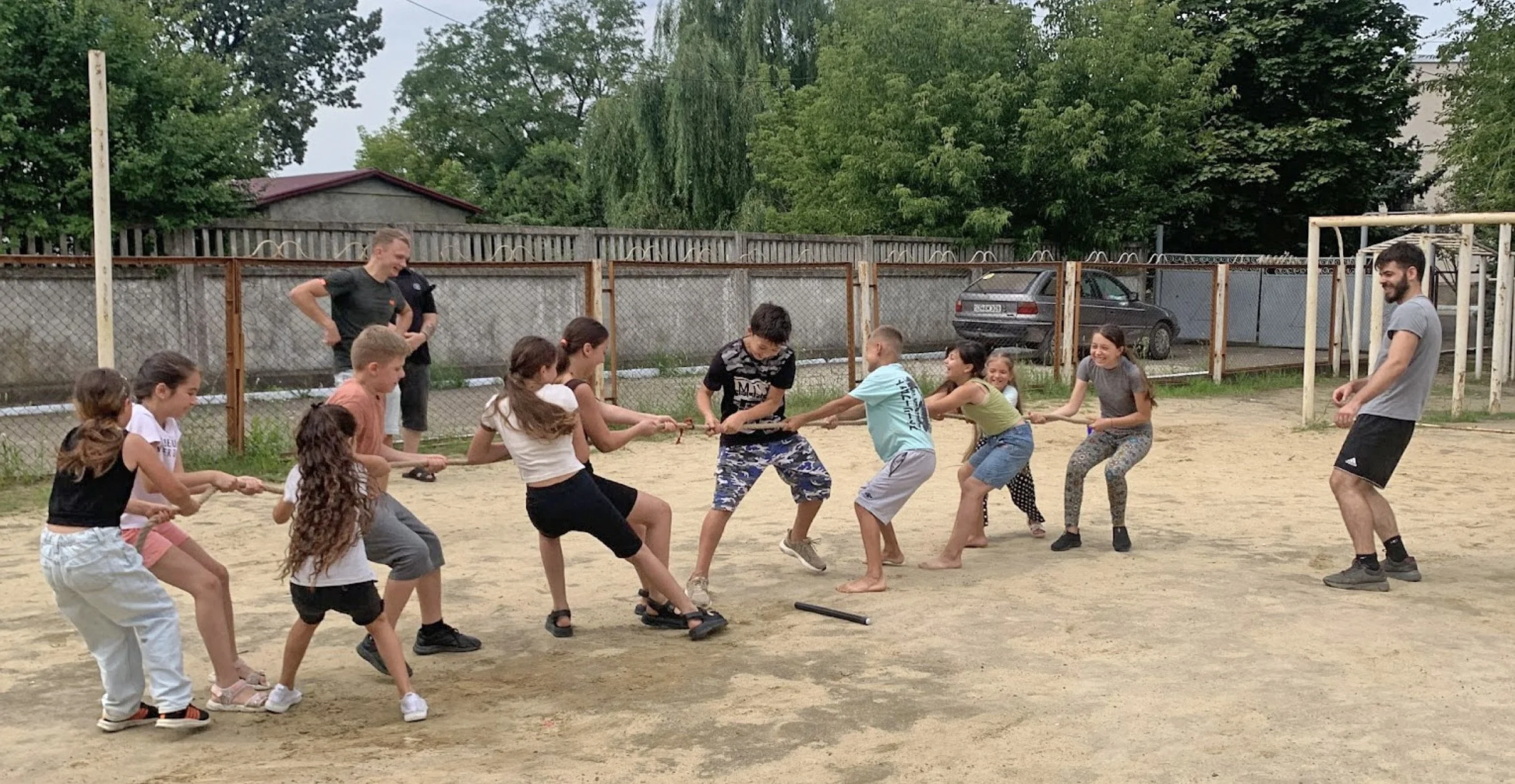
The children happily welcomed us into their activities and were excited to show us what English they knew. We were both struck by the kindness of the children. It was important to them to make sure we were included and that we understood and followed the rules of the games. By the end of the second day we were both decorated in bracelets, necklaces and rings and had been given several drawings (which the children were careful to make sure were in our favourite colors). It was clear to us that the children were happy to have us there, and we were honored to have been so warmly welcomed.

Davide (right in black shorts) encourages the kids to PULL!

By Friday, we were feeling confident that we knew how the center worked, but we were soon to find that no two days were the same at the Phoenix Center! Klara had managed to secure a visit from trainers from Chisinau, Moldova’s capital city, to lead a seminar on financial responsibility for teenagers and young adults. We were invited to join, and so we gladly did, thinking that it would perhaps be an hour or so. How wrong we were! It turned out to be a whole day affair including many icebreaker games and a long role-playing game in which we assumed the role of family members and had to make decisions on different scenarios. With Davide playing the role of the breadwinning son in his team, and Thomas the disruptive Babushka in his, we did our best to steer our teams to victory. This also gave us time to chat and get to know some of the young people of the area.

Weeks at the Phoenix Center run from Tuesday to Saturday. The day got off to a slow start, but after lunch the children began arriving and we were soon back into our routines of table tennis and arts & crafts. As we left the center at the end of the day, we were both buzzing with inspiration and ideas for what we would like to put in place in the following four weeks here.

Be sure to check out Part II here.

Click here to learn more about our programs in Moldova.

Help Syrian Children Get Back To School in Jordan!

by Brigid Rowlings, LHI Communications Director

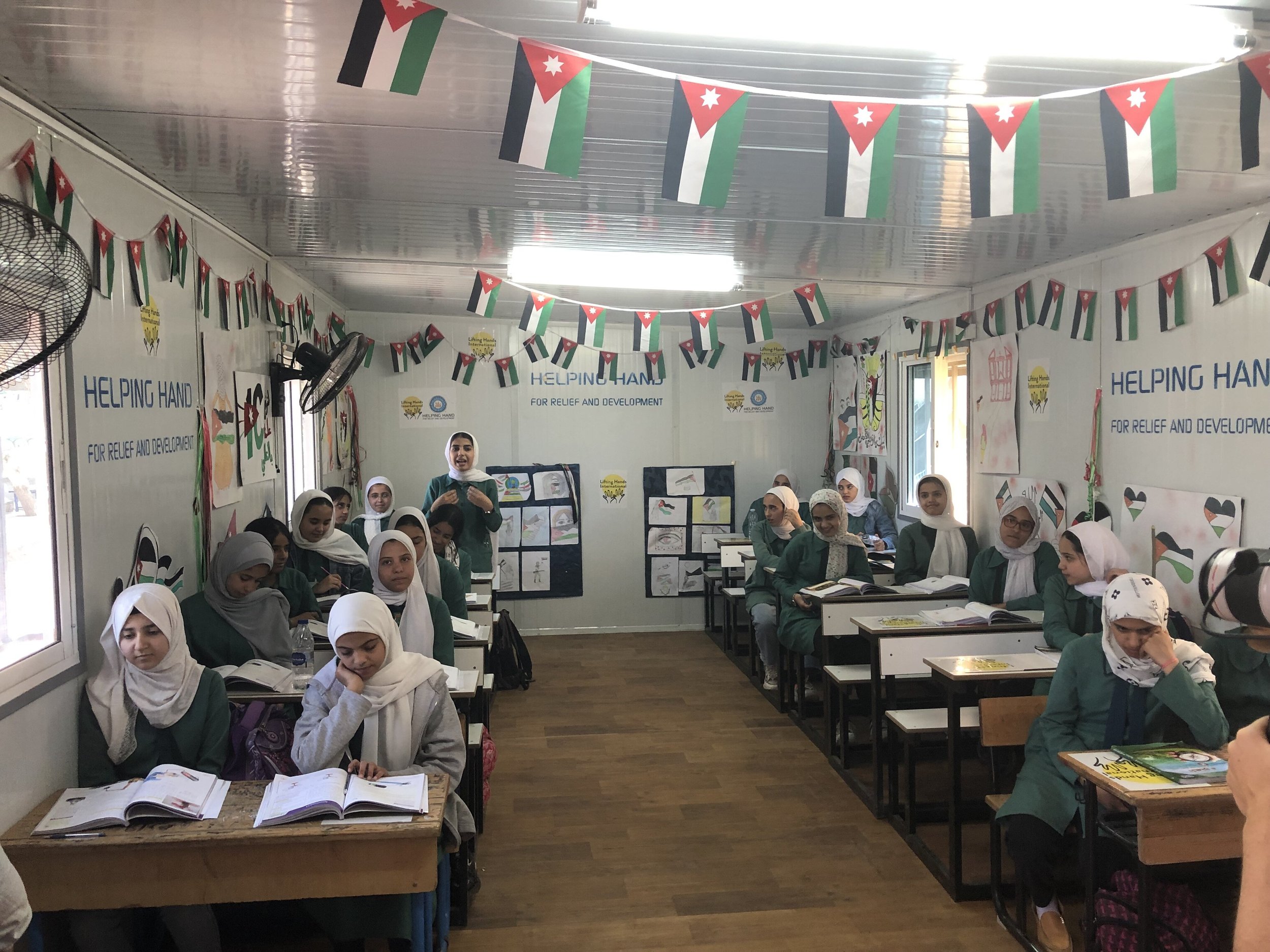
Many Syrian students are able to attend school in Jordan thanks to these innovative modular classrooms. Don’t you love seeing all the amazing work on the walls? Oh, and the LHI logos aren’t to shabby either!

According to the UNHCR, almost half (48%) of refugee kids miss out on school. Sometimes, there's no school nearby, fees are too high, or the host country won't allow them in public schools. 

In the case of Syrian refugees living in Jordan, a major challenge is space. Due to the massive influx of Syrian families into Jordan, schools started holding two shifts a day to accommodate both local and also Syrian children. And there still isn’t enough room. 

One solution LHI has been quietly piloting over the last couple of years is providing modular classrooms complete with electrical connections, furniture, and bathrooms right on public school campuses. From there, Jordan’s Ministry of Education pays teacher salaries and takes care of maintenance. Just one classroom can accommodate 40 children using the two-shift-a-day model. Best of all, it only takes $13,000 to install each classroom. That’s just $65 per child over a 5 year period!


Now that we’ve installed five mobile classrooms in Jordan and have seen the tremendous impact they’ve had, we are ready to get louder about this program. We need your help. We are running our back-to-school fundraiser focused on getting Syrian children in Jordan back to school! 

As you are perhaps getting your own children ready for a new school year, or watching the neighborhood kids wait for the bus, why not take a moment to help Syrian children get back to school as well? A donation of any size will help a child to learn, grow, and thrive. If you are on Facebook, you can visit our Facebook fundraiser page by clicking here. Or, you can visit our website to make a donation by clicking here.

About me: I was a secondary school teacher in high-needs public schools in the metro-Boston area for almost 20 years. In that time, I worked with incredible students, many of whom were facing hardships including poverty, homelessness, food insecurity, immigration concerns, and learning disabilities. I believe that education is a basic human right. My greatest wish is for internally displaced or refugee children to get the education they deserve.

How Stuff Works: Responding to the Dam Catastrophe in Ukraine

by Brigid Rowlings, LHI Communications Director

Our teams continue to pump flood water out of homes and businesses. Serhii (middle), LHI’s Ukraine country director, has coordinated a huge response. 

There are two fundamental truths when it comes to refugee work:

  1. No single organization can tackle a crisis alone.

  2. Refugees and displaced people understand their own needs best.

When we combine these two truths, we arrive at one of LHI's signature approaches: Providing high-level operational expertise to our local teams.

Our Ukraine response is a perfect example of this. We've set up ten operating centers throughout the country that we run with our local teams, each of whom provides a myriad of services.

When Russian forces destroyed Kakhova Dam in the Kherson region of Ukraine, 545,000 acres of rich farmland and villages were flooded with water that quickly became toxic from decomposing wildlife, chemicals and floating explosives. People needed rescuing from flooded homes and taken to shelters. Many people needed medical attention, including treatment for hypothermia and shock. 


The team at the LHI Operating Center in Kherson hunkering down in their basement during a shelling attack.


As it happens, one of our ten operating centers is located right in the heart of Kherson. Our Ukraine Country Director Serhii immediately called our team to see what we could do. Within a couple of hours, we were evacuating people from the floods by boat. And a few days later, we purchased an industrial-quality truck to pump toxic water out of flooded homes. Simply put, there is no way we could’ve done this on our own, without our team in Kherson. 


The NGO Hub in Kyiv became an emergency response center.


Our response to the flood extended beyond our operating center in Kherson. For example:

  • The LHI Shelter in Lviv has taken in people displaced by the flooding. 

  • Our partner forPeace organized a shipment of water filters to protect flood survivors from contaminated water. 

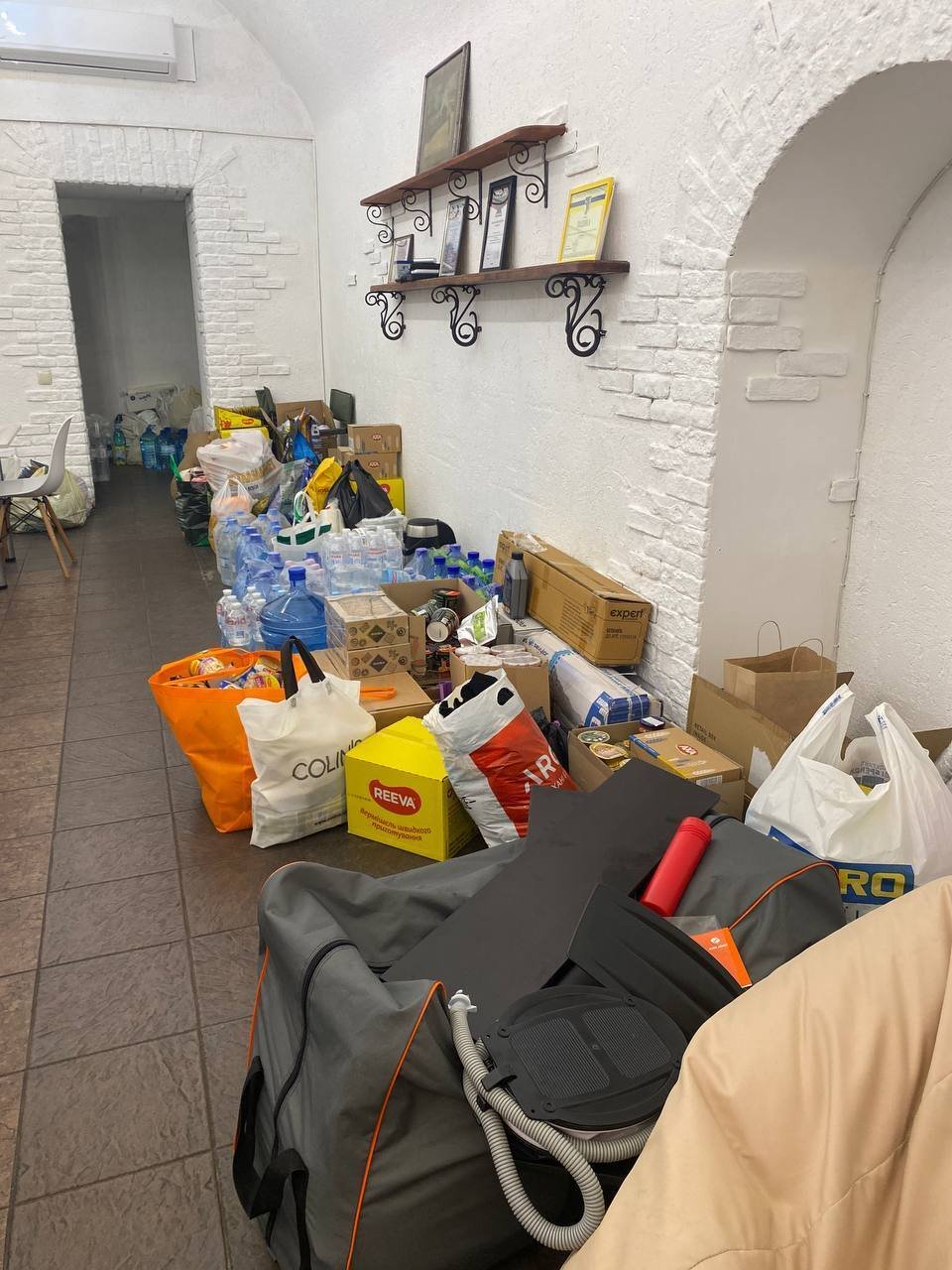
  • We turned our NGO Hub in Kyiv into a coordination center and temporary aid collection point for response to the disaster. 

  • And, we were surprised to learn that a frontline hospital we’d supplied medical equipment to used those very supplies to treat flood victims who suffered hypothermia.


Our teams sourced boats and fuel to rescue people stranded in flood waters.


LHI's rapid, efficient, and effective response to the humanitarian emergency caused by the Kakhova Dam rupture was made possible through strong partnerships with local people and organizations.

Learn more about our commitment to empowering ordinary Ukrainians to assist their fellow citizens in need and support our cause by donating towards the purchase of essential items. Visit our Ukraine response page by clicking here.

How Stuff Works: Building Community Centers in Greece and Moldova

by Brigid Rowlings, LHI Communications Director

Like these shoes we distributed to beneficiaries at the LHI Community Center in Serres, Greece, one size does not fit all when it comes to humanitarian work.

Refugee work does not lend itself to a one-size-fits-all solution. With 110 million refugees and internally displaced people around the world, aid organizations, both smaller groups like LHI and larger organizations like the UNHCR, must consider a wide range of factors when responding to the needs of refugees. For example: What is the political climate in the country hosting refugees? Are refugees allowed to attend school or work in the host country? Do refugees have access to traditional housing, or are they relegated to refugee camps? What governing body is responsible for managing refugee issues? What is the best way to work with these organizations?

Over the next few weeks, we will provide some insight into how LHI responds to different refugee situations. 

A TALE OF TWO REFUGEE COMMUNITY CENTERS

We founded the LHI Community Center in Greece in August, 2016. Our primary goal was to provide refugees a sense of community, a shared sense of belonging and understanding. Situated adjacent to two refugee camps in Serres, Greece, it is a place that brings people and cultures together through shared ownership of the space and its activities. 


At the LHI Community Center in Serres, Greece, community members and volunteers often share food and traditions from their home countries with each other as a way to connect and build community across cultures.


Earlier this year, we officially opened a similar program for Ukrainian refugees living in Moldova. The goals of both community centers are the same (providing healing psychosocial and material support to refugees), but their contexts are very different. 


Children enjoy an art project at the LHI Community Center in Balti, Moldova.


SPOT THE DIFFERENCES

Let’s start with Greece. Geographically, Greece is the gateway to Europe when coming from the East. It is a long and dangerous journey for refugees, many of whom cannot return home. However, once in Greece, asylum cases can take years to process, and the government provides little financial support. Refugees cannot work, and refugee camps can be crowded. Anti-refugee prejudice is present, and international aid organizations are not entirely welcome. 

Now, on to Moldova. Moldova shares a 700 mile border with Ukraine, so it is a natural destination for those fleeing Ukraine. Unlike in Greece, there are no refugee camps in Moldova; instead, Ukrainian refugees live within the local communities, occupying family homes, rented apartments, or designated shelters. The Moldovan government has generally been welcoming to refugees from Ukraine, allowing them to work and have a more secure legal status than in Greece. Ukrainian refugees still hope to return to their home country when it's safe enough to do so. 

It’s worth noting that Moldova has struggled with poverty for decades, and in some cases, Ukrainian refugees get more financial and material help than native Moldovans. While this has resulted in occasional tensions, the majority of Moldovans remain welcoming and hospitable to Ukrainians. 

SIMILAR GOALS, DIFFERENT CONTEXT

GREECE

The refugee camps in Serres, Greece, house people from various nationalities and who speak different languages such as Yazidis, Ukrainians, Syrians, and Afghanis. At the LHI Community Center, we strive to create a safe and welcoming environment where everyone can feel a sense of community, regardless of their origin. We organize activities where participants can share their cultures, traditions, and food with each other. We also encourage sports, women’s activities, children’s activities, play, fun, and music as a means of bringing people together.


People often enjoy making music together at the Arts and Recreation space at the LHI Community Center in Greece.


Because the political climate in Greece can be hostile towards refugees and aid organizations, we run the LHI Community Center independently from the government-appointed administration and refugee camps. We regularly consult with the refugee community to ensure our programs meet their needs and interests, especially if they do not have access to services in the host country. For instance, as many community members are scheduled to resettle in Germany, German language classes are in high demand.

MOLDOVA

At the LHI Community Center in Balti, both Ukrainians and local Moldovans come together as part of our mission to foster community and help those most in need.

While beneficiaries in Moldova do not live in refugee camps, we try to identify those who may feel isolated and lonely in the local community. We use a lot of social media and word of mouth to let beneficiaries know about our center.

Because Ukrainians living in Moldova do hope to return home someday, and because many Ukrainians are able to work in Moldova, there is not as much of a demand for language or skills building classes as there is in Greece. There is however a huge demand for fitness and creative arts classes, both of which lend healing and comfort to those who wait in limbo to return to Ukraine.


These community members enjoy a fitness class at the LHI Community Center in Moldova.


And so there you have it. Despite the differences between the refugee contexts in Greece and Moldova, LHI was able to take a good idea—a refugee community center—and customize it to meet the needs of the place and the people it benefits.

Stay tuned for an upcoming blog post where we talk about how responding to one natural disaster that affected two different countries and required two very different responses.

More Help is on the Way for Refugees in Utah and Abroad

FOR IMMEDIATE RELEASE


More Help is on the Way for Refugees in Utah and Abroad

Local Nonprofit Is on the Frontlines of Helping Thousands of Refugees, in Response to Global Crisis

American Fork, May 24 - Lifting Hands International (LHI) a prominent Utah-based nonprofit organization with a humanitarian hub in American Fork, continues to provide critical support to refugees in Utah and abroad. A recent shipment of hygiene kits, shirts, and underwear was dispatched to ‘Team Brownsville’ in Texas at the border, with others scheduled for Ukraine and Jordan this week. LHI swiftly adapts to changing world circumstances, customizing their aid and shipments to meet refugee needs.

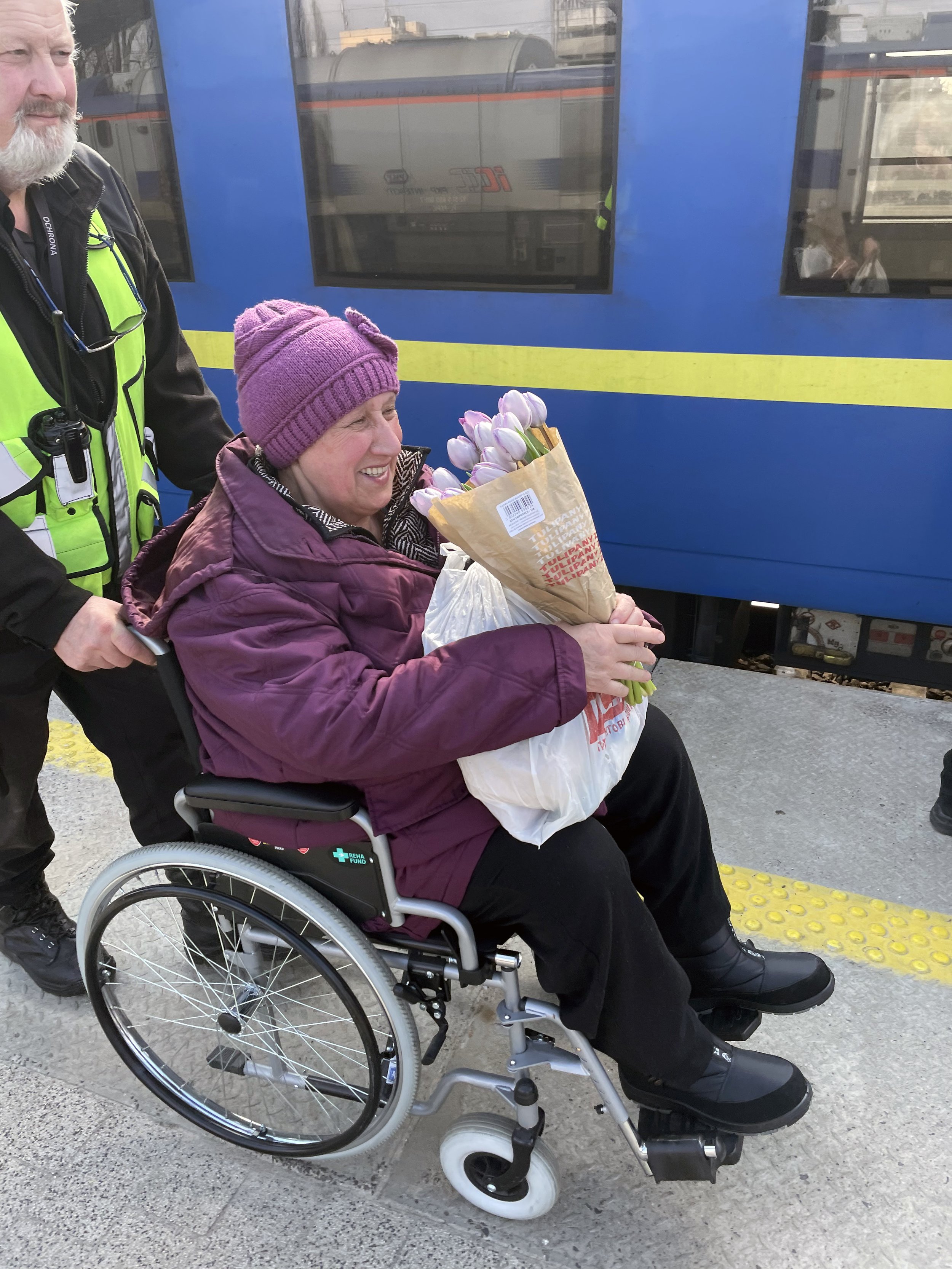
Riya after being rescued from her 9th floor apartment in Ukraine receives help at the Warsaw Central Station on her journey to Utah. 

A Story of Hope From Inside the LHI Warehouse

The ongoing Russian aggression in Ukraine, deadly global natural disasters, and a burgeoning flow of migrants seeking shelter in the U.S., has LHI on the front lines of helping countless individuals and families who are seeking refuge from the horrors of war, persecution, and natural disaster. Riya an elderly woman from Ukraine, disabled and traumatized by the war, recently found solace in LHI's care. Trapped on the 9th floor of an apartment building during the conflict, she endured sleepless nights filled with fear and thoughts of impending death. Eventually, her niece Maryna rescued her and brought her to Utah, where LHI's Director of Humanitarian Aid, Traci Parson, greeted her with a compassionate hug. Overwhelmed with relief and gratitude, Riya burst into tears, thankful for the welcome and desperately needed items LHI provided to help rebuild her life.

Ryia (middle) reunited with niece Marya (right) in Utah at her grand-nieces dance recital.

The Impact

As global crises intensify, the number of displaced individuals and families has reached unprecedented levels, escalating the need for humanitarian aid, particularly for refugees from war-torn countries like Ukraine, Syria, and Afghanistan, earthquake victims in Turkey and Syria, and legal asylum seekers in U.S. border shelters. Many refugees escape with only the clothes on their backs and families are often separated, making LHI a lifeline for alleviating their suffering and meeting their basic needs. 

A Syrian refugee boy in Jordan receives some aid supplies, along with one of LHI’s signature 'You Are Loved' cards, which are included in every aid bundle.

Welcome to Your New Home

LHI's Welcome Program for refugees resettling in Utah helps to equip incoming families and individuals with home goods, including bedding, kitchen supplies, bathroom essentials, cleaning items, and food. Moreover, in response to growing demand, LHI has successfully set up hundreds of apartments for refugee families in partnership with the local resettlement agencies, International Rescue Committee (IRC) and Catholic Community Services (CCS).

Hayley Smith (LHI Founder / Director) and Jaron Malyon (LHI Director of Monitoring and Evaluations) distributing aid to earthquake victims in Turkey.

By extending a helping hand, Utahns can immensely impact the lives of refugees facing unimaginable challenges. LHI encourages individuals, groups, businesses, and organizations to join their cause by donating essential items, making kits or blankets, assisting with apartment setups, or making financial contributions. A comprehensive list of urgently needed items and instructions on how to donate can be found on LHI's website at https://lhi.org/needs-list.


For media inquiries, please contact:
info@lhi.org

About Lifting Hands International: 

Lifting Hands International (LHI) is a leading nonprofit organization based in American Fork that offers critical support to refugees in Utah and abroad. Simply humanitarian. Through collaborative partnerships and swift action, LHI provides humanitarian aid, resettlement assistance, and essential supplies to those fleeing war, persecution, disaster, or legally seeking asylum. With a strong presence in Utah and internationally, LHI aims to restore hope and dignity to vulnerable populations, empowering them to rebuild their lives.


The LHI Difference: Humanitarian Aid From Person to Person

by Brigid Rowlings, LHI Communications Director

Edu, LHI’s Director of Field Operations in Moldova, distributes toys to Ukrainian refugee children.

Yesterday morning, I was busy getting the kids ready for school. As usual, I had one AirPod in so that I could catch Morning Edition while also fielding breakfast requests and packing snack bags. My ears perked up when I heard the intro to a story about how the Turkish city of Sanliurfa is using lessons learned from welcoming Syrian refugees to assist people displaced by the earthquakes.

As I listened, the words of an interviewee, Ali Altin, who runs a distribution center in Sanliurfa, caught my attention. He observed that Syrian war refugees and earthquake survivors share this similarity: “Families who have never wanted for anything before in their lives are suddenly in need of a single diaper, and you can sense they don’t know how to tell you what they need and are almost apologetic for asking.”

This statement brought me back to a voice memo Edu, LHI’s Director of Field Operations in Moldova, sent me a few weeks back about why he thinks it is important that he is there, on the ground, when aid is distributed. And, since Edu took a good deal of time to send me the voice memo, I’ll let him take the lead in telling you why LHI’s practice of having team members at humanitarian aid distributions as often as possible is so important.


Edu often opens boxes of aid with beneficiaries. This gives him an opportunity to talk with people and to better understand their situation and their needs.


Being present at distributions brings humanity and dignity to a moment that is quite delicate.

Edu told me, “I think that asking for humanitarian aid, asking for help is something that can be humiliating. It makes people feel vulnerable and nobody likes it. So that is the starting point. And I think if I am there, wearing LHI gear, representing the organization, it brings some humanity to this process, and makes the beneficiaries feel better because they know it's from human to human.”

Edu also shared that some NGOs unload boxes of aid and leave. He said that the effect of this is that: “they don’t even know refugees faces. This could be quite undignifying for them, for the people who receive the support, and that is unfortunately how it works usually. They just load a truck with stuff, send it to the village where there is need, unload it, and that is it. People don’t even know where these things come from, who donated, and probably they get a feeling that the donors don’t care much about them. 

When I take part in a distribution, people can say thank you to me. That brings a bit of dignity and humanity in the process- in this moment that is quite delicate.

Refugees remember more about LHI. There is a person who makes the moment more memorable. It makes it a nicer experience.”


Edu spent some time playing with Ukrainian children sheltering in the dorms at university in Chisinau, Moldova. Edu got the idea to set up a playroom when he saw the children playing in the narrow corridors during an aid distribution.


Meeting beneficiaries helps LHI to get to know them, to better understand their needs, and to help them get the aid and services they are not able to get anywhere else.

Edu told me that when he is present at distributions, “I get to know the real situation. I get to see where the refugees live and what are their needs. I get to talk to them. I get to listen to them. I could not have such a grasp on their lives if I were not there.”

Edu’s presence at one distribution led to one of LHI’s coolest projects in Moldova. He said: “When I distributed aid to a university [that shelters Ukrainian refugees in its dormitories], I saw the kids playing in the corridor and then I had the idea that maybe we could set up a playroom for these kids. That has been one of the most successful projects so far in Moldova, and that idea just sparked during a distribution.”


LHI founder and director Hayley Smith talks with a woman during a distribution of aid to earthquake survivors in Turkey.


LHI’s COO Walker echoed Edu’s sentiments recently in a staff meeting when he reflected on his recent visit to earthquake survivors in Turkey. He told us about a Syrian refugee he met who’d first lost three of her children in Syria because of the civil war, and had now lost six more children in the earthquake. She and other women and children were sleeping on the floor in a mosque. What they needed were mattresses so that they could get off of the cold, hard floor. Because of this conversation, LHI was able to provide the people sleeping in the mosque that small, but much needed, comfort.


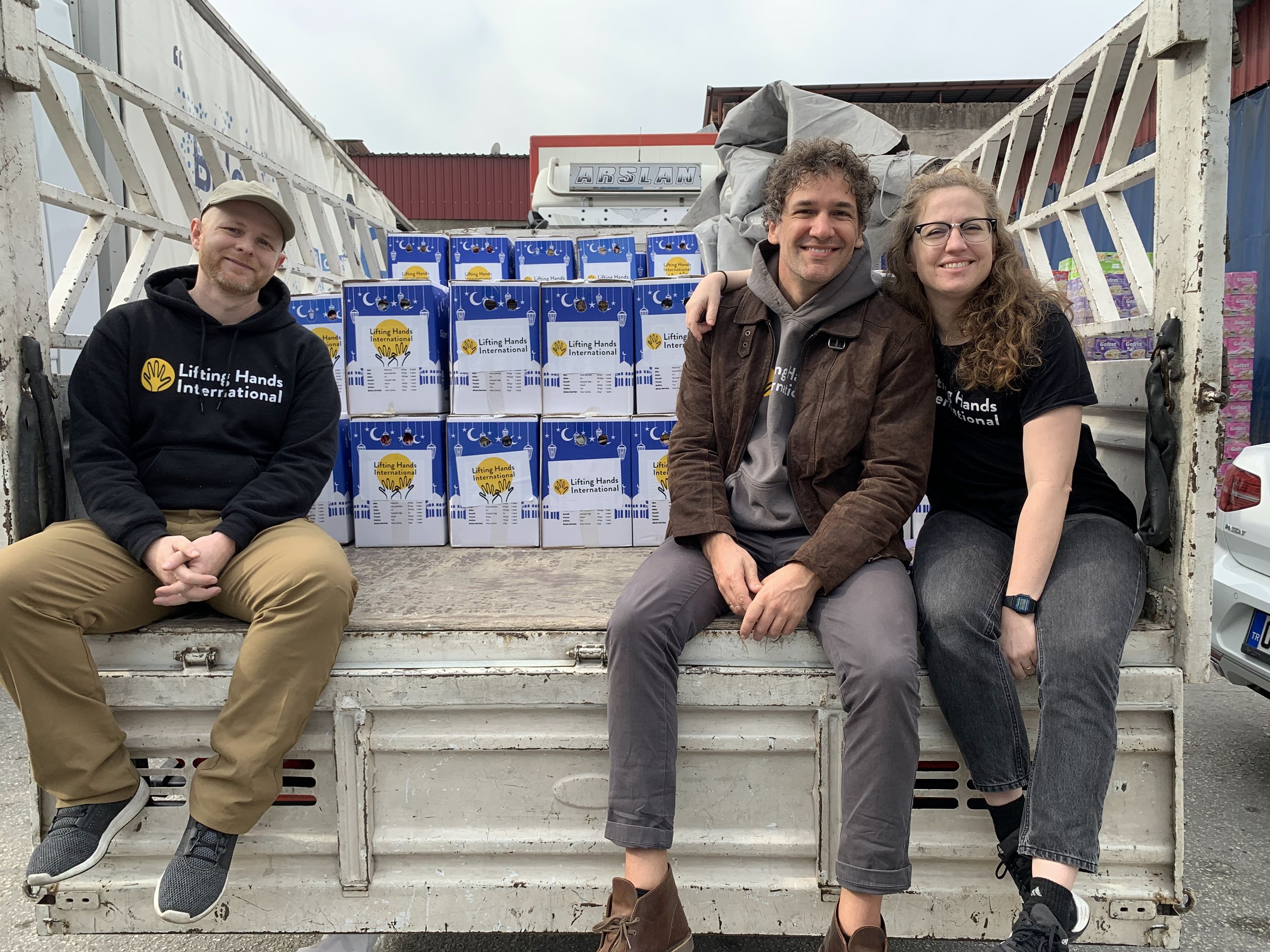
LHI’s Walker, Jaron, and Hayley recently traveled through Turkey to personally distribute aid to earthquake survivors.


Walker also told us that he spent some time playing with the children who were sheltering at the mosque. He said, “There is not much for [earthquake survivors] to do.” Many people are not working because they’ve been displaced from their homes, or because their workplaces have been destroyed, or because supply chains have been greatly disrupted. Children are not in school because buildings are damaged or teachers have been killed or displaced. In light of this, Walker said, “It feels very valuable to play with the kids and engage them.”


LHI’s Ukraine country director Serhii (he’s the one with the sunglasses on his head) recently traveled to Kherson where he met with volunteers who serve their community and affected villages at great risk to themselves. Meeting people and forming partnerships is how LHI gets its work done.


The relationships and partnerships that pave the way for LHI to do its work are forged on the ground.

Serhii, our Ukraine country director, puts this best. He told me:

“A partnership isn't built by phone calls, emails, or agreements. It is forged on dusty roads and in destroyed villages. [Before joining LHI], I was doing massive projects with dozens of teammates and thousands of beneficiaries, and it was easy to lose the sense of human connection. My job isn't about metric tons or quantity; that's about connecting the dots and ultimately bringing people together. That's why I travel with our fantastic partners, whenever possible, to the most affected areas. We drive, unload aid and sometimes seek shelter together.

Now I can see the hard work of our partners, share the team spirit and remind myself about the very essence of humanitarianism. We build hope, empower people, and come together as a big family.”

And I think Serhii hits the nail on the head: the essence of humanitarianism is seeing the humanity in our beneficiaries and partners and working together to provide the things people need to maintain or rebuild their sense of dignity and self-sufficiency.

If you’d like to learn more about our team , our work, and how you can help, please visit our website!

Q and A With Turkish-Born LHI Board Member Leslie Schick

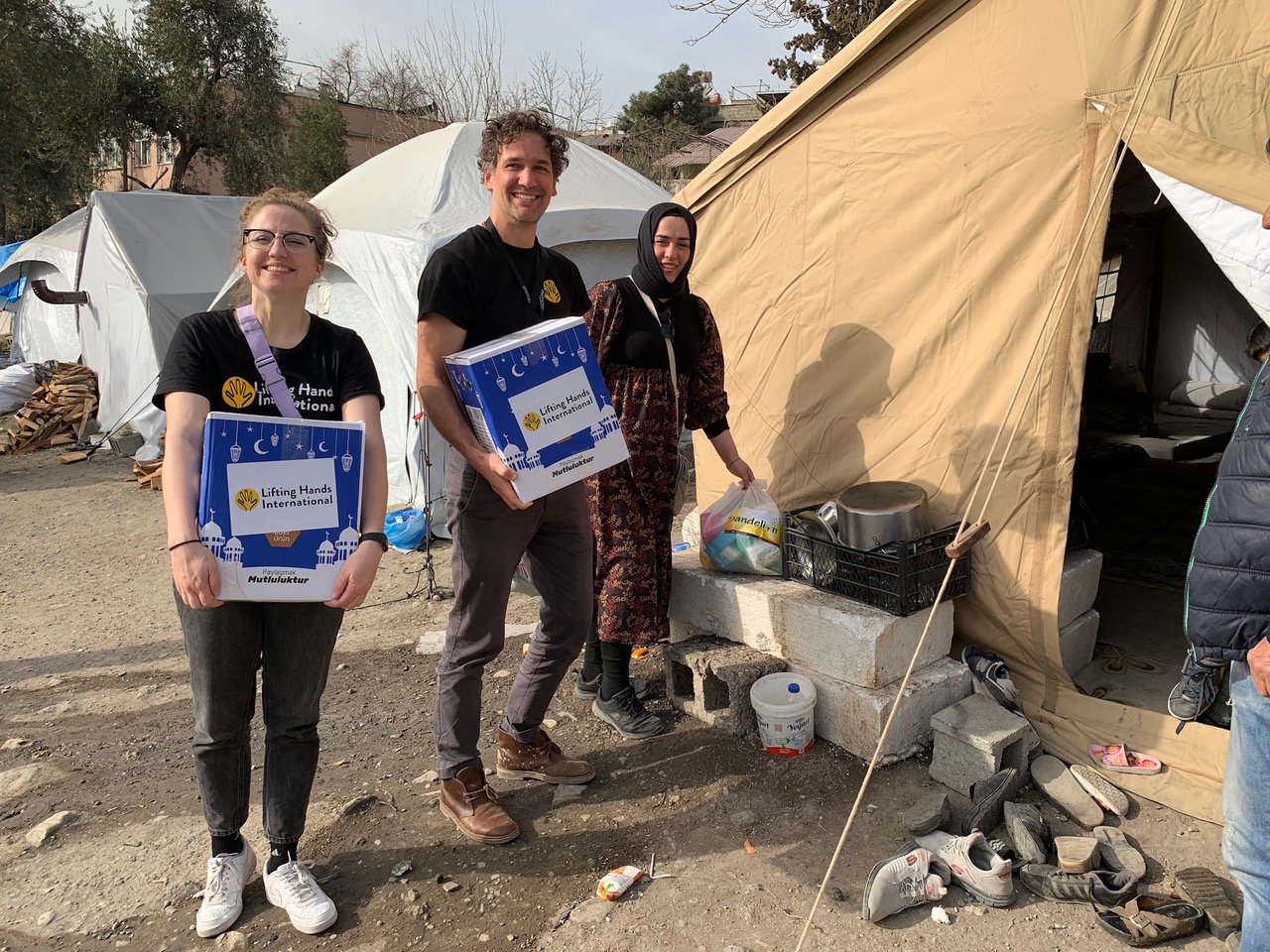
LHI Founder and Director Hayley Smith spent a half hour with this family who now live in a tent city in the middle of Kahramanmaraş, Turkey, the epicenter of the earthquake. They lost their home and all of their belongings.

One of LHI’s board members, Leslie Schick, was born in Turkey and resides in Boston with her family. Last week, prior to our trip to Turkey, she shared her perspective on the devastating earthquake that has affected Turkey and Syria.

LHI: Can you describe how you’ve felt watching from afar as this tragic disaster has unfolded in your native country?

Leslie: It’s been hard to think of anything else or to concentrate on anything else. I’ve been obsessively following the news and social media, and talking to friends who are in Turkey. It’s a collective trauma and pain. The news cycle and people here [in the United States] have moved on, whereas it’s all feeling still very current. So that has been difficult to deal with. 


This man was happy to talk to the team from LHI, the first aid organization to come to his remote mountain village since the earthquake. His home was seriously damaged, and he now lives in a tent in his backyard with his family.


LHI: Conditions in Turkey were already pretty challenging even before the earthquakes, right?

Leslie: Yes, the economy has been steadily declining. The inflation rate is staggering, as is the rate of unemployment. And people are truly struggling to support themselves. In the case of many, they’re struggling just to put food on the table. This is also an area that houses a disproportionate number of Syrian refugees.


One of many destroyed homes the LHI team passed on our drive to Antakya. According to Reuters, “more than 160,000 buildings containing 520,000 apartments collapsed or were severely damaged in Turkey by the disaster, the worst in the country’s modern history.”


LHI: What challenges are Syrian and other refugees within the earthquake zone facing right now?

Leslie: Turkey hosts the largest number of registered refugees, or persons under protection, in the world. While that number was about 20,000, before 2011, it’s now in the 4 million range for Syrians, and between one and two million for other refugees, mostly from Afghanistan, Iran and Iraq. The most needed aid, for instance, tents, heaters, stoves, etc, is in very, very short supply, and Syrians, in general, are finding it much harder to source these things.


People whose homes had been destroyed by the earthquake talk to aid workers outside of their apartment buildings.


LHI: What are the most urgent needs right now?

Leslie: It’s hard to believe, but the most acute and urgent need now, two weeks on, remains basic shelter. I’m in a number of groups where everyone is requesting tents and none are to be found. And following the two new earthquakes today, Monday, February 20, this need has become even more acute. To quote a local mayor, he says, “Our citizens are demanding tents. No one can convince our citizens to re-enter their homes now. This issue has still not been resolved.” When there’s news of a supply of tents arriving, it’s always exhausted before most people can obtain one. Beyond that, sources of heat, such as wood or coal burning stoves, are needed. Mattresses, sleeping bags, food, clothes, and very importantly power banks or battery packs for phones, or other reliable ways for people to charge their phones, because phones remain the main and best way for people both to stay informed and to stay connected with their friends and relatives who have been dispersed.

 LHI: For those of us watching on the news and seeing the devastation and wanting to do something, what can we do to help?

Leslie: At the moment, the primary way to effectively help, I think, is by donating funds so that organizations on the ground can maximize their efforts. This is not currently a place for untrained volunteers or independent volunteers to think about going right now. Also the scale of devastation is such that only trained teams or teams connecting with organizations that are already on the ground can be effective. Also, Turkey is a country that produces clothing, food, and all necessities. Basic needs are locally available. So the main need is for funds to procure them. Tech needs, such as charging stations have to be fulfilled by specialized teams and are highly needed. Psychosocial support is needed and will in the future also be very much needed to help this population overcome their collective trauma and sense of loss.

Click here to learn more and support LHI’s relief efforts in Turkey.

Conversations In Ukraine

by Hayley Smith, LHI Founder and Director

The LHI team holds a meeting by candlelight at a cafe in Odessa.

LHI founder and director Hayley Smith visited Ukraine in December to visit our operating centers and assess the needs of everyday Ukrainians. Here, she shares some of the conversations she had when she was on the ground.

Odessa, southwestern Ukraine

Me: “I can’t hear you!”

Colleague: “What?”

Me: “I CAN’T HEAR YOU!”

Colleague: “IT’S BECAUSE OF THE GENERATORS”

Me: “I KNOW!”

This is how conversations in Odessa, Ukraine go these days. With regular power outages, people have resorted to power generators. Loud power generators! Every business and every apartment complex is running a generator. Street lights aren’t hooked up to a generator, which is why we pass a few minor car crashes along on our way to a meeting in a local cafe.During that meeting, the city power came back on. The cafe staff turned off the generator as I was mid-sentence. I realized I’d been yelling over the generator. But about ten minutes later, everything went dark again and the  ‘ol generator roared to life once again.


A dedicated but exhausted surgical nurse in Kryvyi Rih.


Kryvyi Rih, eastern Ukraine

Doctor: “May I please ask you something?”

Me: “Of course!”

Doctor: “Please do not post any of the pictures of the hospital from the outside.”

Me: “Oh okay, no problem.”

Doctor: “It is because the hospital is a target, you see.”


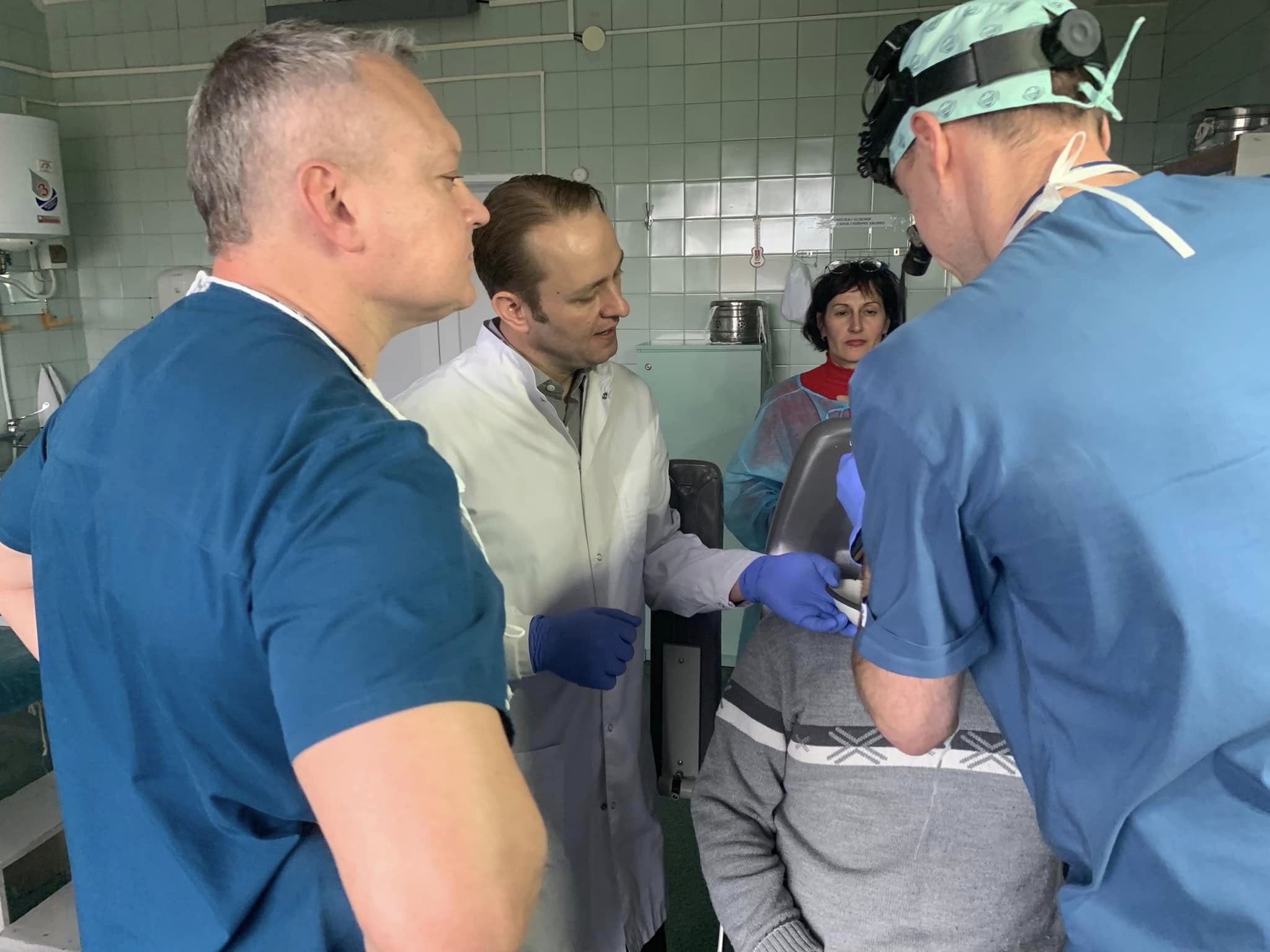
Two of the maxillofacial surgeons at the hospital.


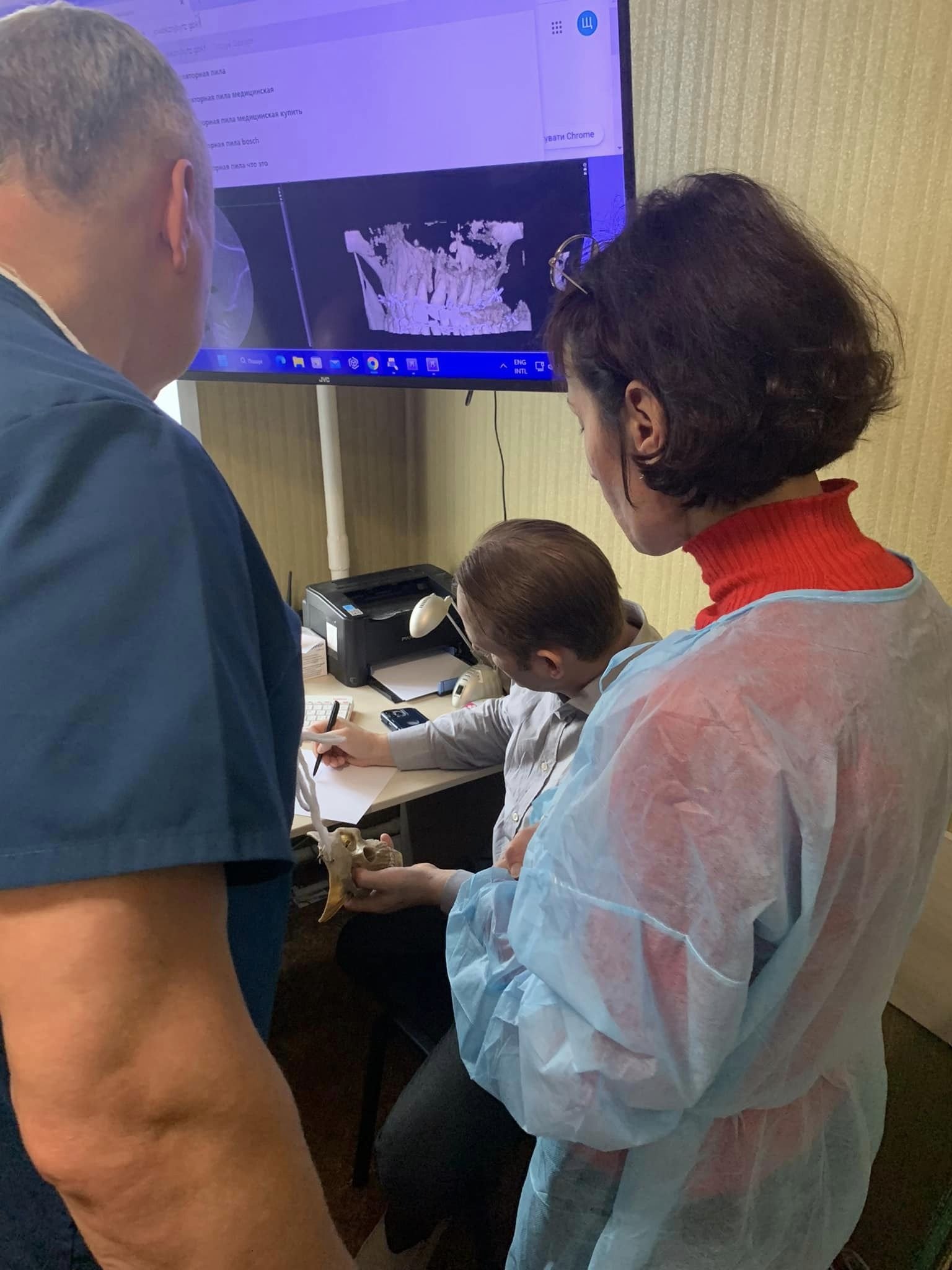
We had just toured the facial reconstruction surgical department at a hospital near the frontlines. We met and talked to two patients who’d recently had surgery. The first was a lady who’d been caught in crossfire and shot in the face from a distance. Because she lived in an occupied part of Ukraine, she couldn’t get proper help until her town was liberated 5 months later. Another man’s jaw was severely damaged by shrapnel. The surgeons did their best considering the frontlines were a couple miles away and casualties were flowing in every day. There was a time where all of the hospital staff just slept at the hospital. 


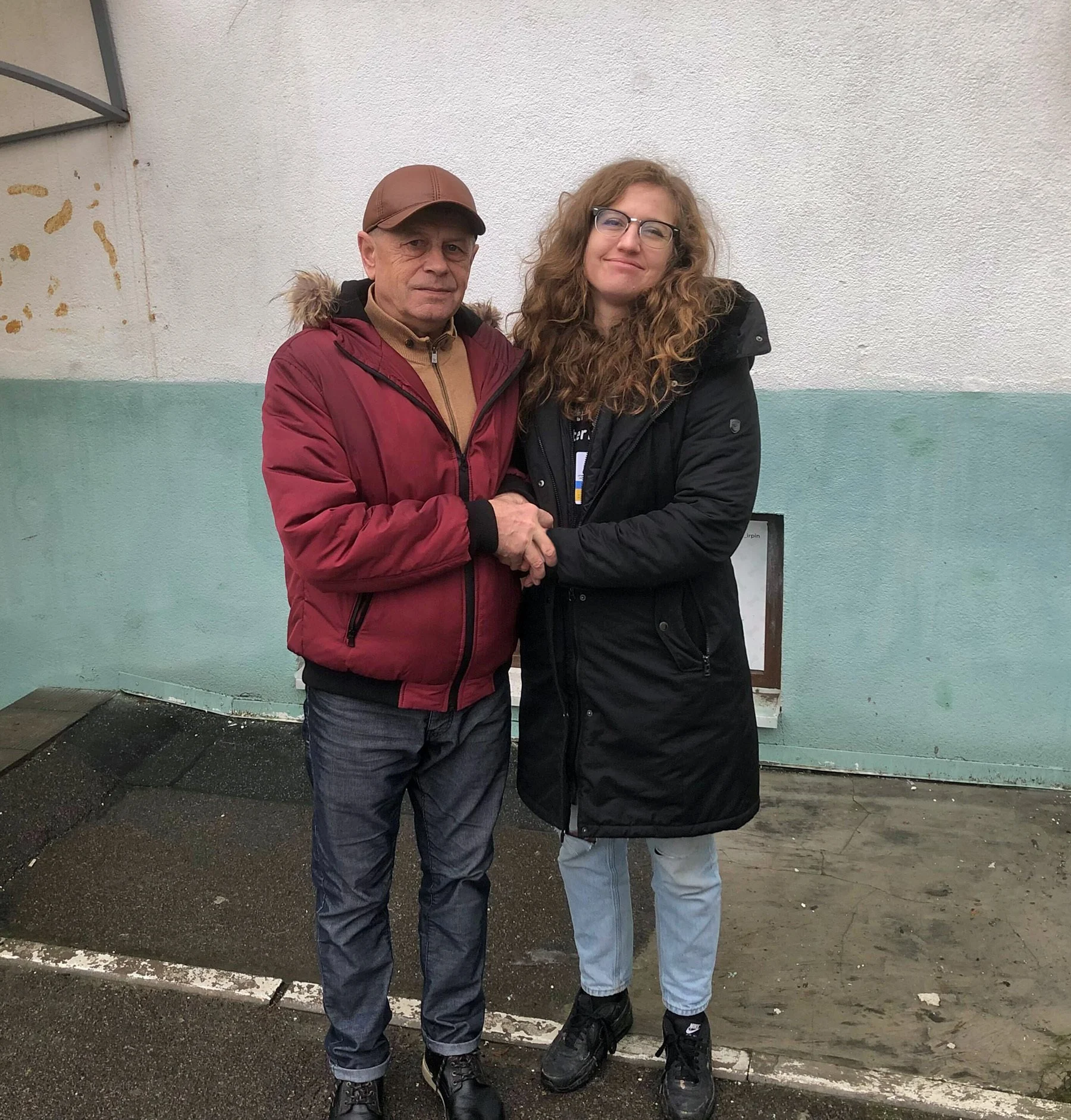
The kind man who shared his story with us.


Irpin, Ukraine (near Kyiv)

Me: “It was so nice to meet you.”

Local man: “My child, I survived the occupation, but will I survive the winter?”

Me: “Of course you will.”

Local man: “Are you sure?”


The team of two friends on the right survived the occupation. They showed us pictures of the damage to an apartment block that they are now repairing.


Occupying forces killed about 300 people in Irpin, most of whom were men. Not fighting men. Just civilians like the man whose hand I was grasping. He had the clearest blue eyes and, at the age of 65, somehow survived when so many others didn’t. After the liberation of Irpin in late March 2022, he and a close friend had taken on a pretty ambitious project of rebuilding a central apartment block that had sustained major damage. It helped him focus on the future rather than remembering the horrific things he witnessed. So, there we stood looking up at the building and all of the repairs, never letting go of each others' hands until I had to move on to the next stop on our humanitarian visit to Ukraine.

When LHI Was Just A Sparkle in Hayley Smith's Eye

by Hayley Smith, LHI Founder and Director

History is made as my family and friends help load the first container of LHI humanitarian aid!

“But nonprofits don’t pay very well!” Those are my mom’s [concerned] words when I told her I was starting Lifting Hands International. And she wasn’t wrong. I reassured her that it would be a small project on the side because, well, I was just one person, and I majored in English and minored in Arabic. No shred of business training in my entire existence. 

That mother/daughter exchange was around this time of year 7 years ago. I’d recently gotten back from a stint as a volunteer in Greece, and I was fired up about what I’d witnessed. My mind wouldn’t stop churning with flashbacks of refugees, soaking from being in the sea and shaking in the cold. I had to do something.

It is hard to believe that LHI’s first aid warehouse was my living room!

So, I filled out the required paperwork, paid the fees, and started a nonprofit. I had a year to find a board and write bylaws, so I put that off for a while. In the meantime, my goal? To fill one container of aid per year, and aid that refugees actually need, not what people assume they need. It wasn’t an ambitious business plan by any means, but one container of organized boxes of critical aid is certainly better than nothing. 

Well, we filled that container in two months, and I thought that was the biggest project LHI would ever do! But LHI just kept growing and growing and growing into the international org it is today! Thank you to our volunteers, supporters, donors, staff, and teams for helping to build Lifting Hands International over the last 7 years.

News from Ukraine: Medical Needs Challenge A Country At War

by Brigid Rowlings, LHI Communications Director

Dr. Aragon Ellwanger assesses a Ukrainian civilian badly injured by shrapnel.

How do civilians seek medical care when their country is at war? This question drew me up short. Hospitals must treat those injured by war, in addition to people who require urgent and long-term care for run-of-the-mill illnesses and injuries. 


Battery powered incubators arrived from LHI to Ukrainian hospitals last month.


Babies

I had intense and unrelenting contractions when I was in labor with my son 10 years ago, and that was without power outages, supply shortages, and lack of heating that so many maternal wards experience in Ukraine. This is why LHI distributed battery-operated incubators to maternity hospitals and NICUs in Ukraine, with the help of Smart Aid. (Readers, remember that this is Brigid writing, not Hayley! Hayley does not have a secret child). 


Health care workers at a surgical clinic near the front lines recently gave our Ukraine country director, Serhii, a tour of their clinic.


ICUs

Serhii, our Ukraine country director, recently visited a frontline surgical clinic in eastern Ukraine. He spoke with Anna, Director of Surgery, who left her job in Kyiv to care for cancer and ICU patients whose treatments were on hold while war injuries were rushing in. With Anna’s guidance and Serhii’s expert fact-finding skills, LHI, in cooperation with our friends at Dead Lawyers Society (yup, it’s a play on the movie Dead Poets Society) funded essential laparoscopic surgical equipment to help Anna and other doctors meet ICU patient needs. 


Dr. Aragon Ellwanger considers how best to treat a civilian patient with a war-related injury.


Civilian war injuries

Face-altering shrapnel and bullet wounds are now commonplace injuries at frontline clinics. I recently talked with Britta Ellwanger from ForPEACE, who works day and night to help on the frontlines. Her brother Dr. Aragon Ellwanger, a United States Air Force trained oral maxillofacial surgeon with experience treating frontline trauma wounds, joined her in Ukraine to assess needs at a frontline hospital. 

He immediately noticed a patient, Volodymyr, whose jaw had been severely damaged by shrapnel. Even after surgery at the local hospital, his jaw had been sewn shut for three months, and he had lost 40 pounds. This is because, well, "how to repair bone shredded by shrapnel" or "how to reconstruct jaws shattered by bullets" are not typical courses in medical school. Another factor in the less-than-ideal surgical outcomes is that a lot of the hospital’s surgical equipment was either outdated or not working

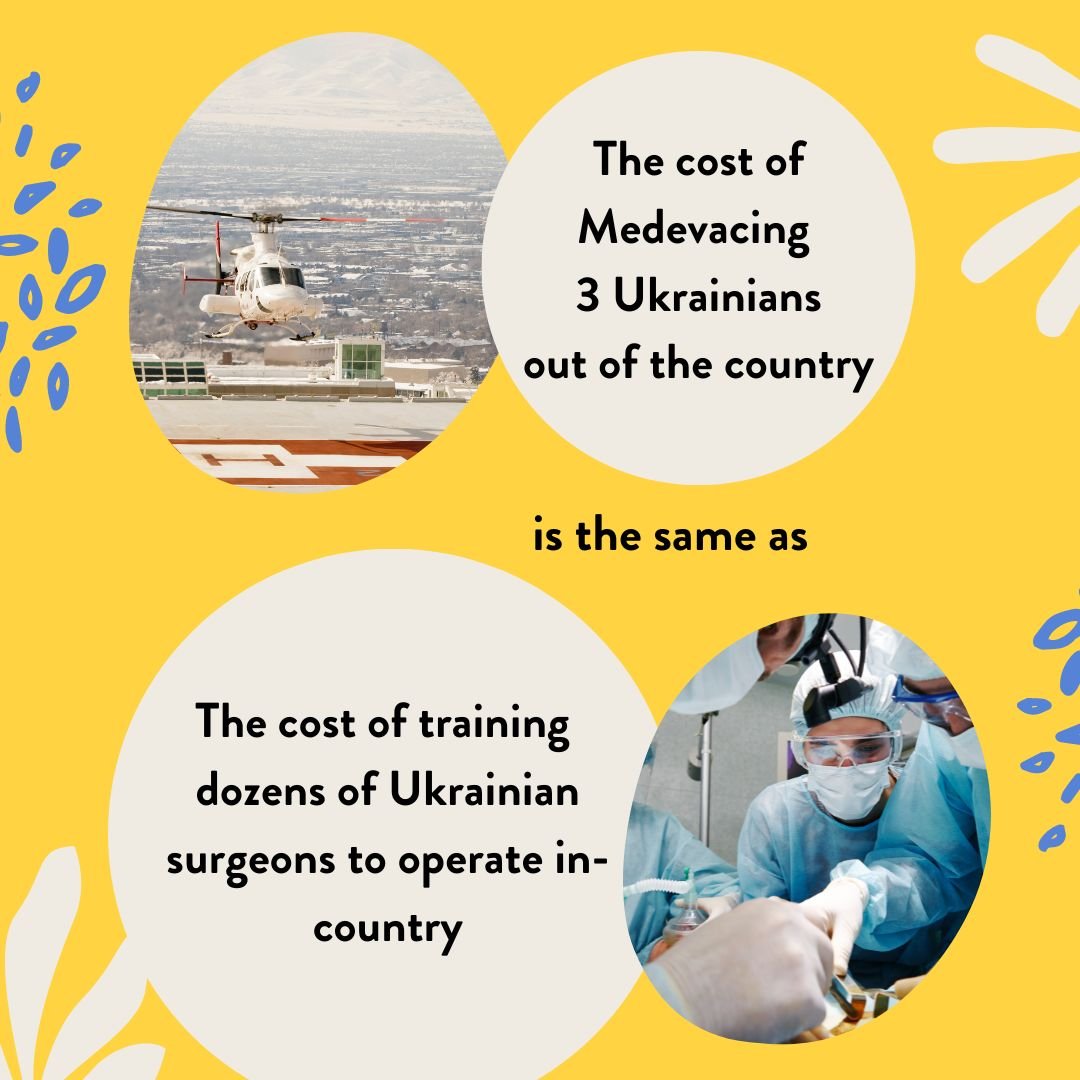
Dr. Ellwanger performed a corrective surgery to undo the first surgery and then reconstruct Volodymyr's jaw. Now he can open his mouth again, talk, eat food, etc. Volodymyr was lucky, however. Patients with severe trauma injuries across Ukraine have to wait months for any sort of treatment. In some cases, family and friends will raise at least $80,000 for a medical evacuation to Western Europe or the USA to receive treatment, but that is a rare case.


Training surgeons

The best solution is to train Ukrainian surgeons in oral maxillofacial wounds and to encourage hospitals to upgrade their equipment. Dr. Ellwanger has sourced a portable medical kit that he can take to frontline hospitals to train their surgeons to treat injuries unique to wartime. 

LHI is partnering with forPeace to cover the cost of this surgical equipment. We are excited that this project centers around training Ukrainian doctors and building the capacity of the healthcare system in Ukraine. We also know that this project will offer hope to hundreds of Ukrainian patients who have suffered devastating injuries.

If you’d like to learn more about this mobile surgical training project, please click here

Beneficiary Spotlight: Refugees from the Americas

by Brigid Rowlings, LHI Communications Director

Images from shelters on the southern border of the United States that LHI supports.

Refugees crossing the southern border of the United States has long been a prominent issue in the American media. It has gained more attention recently as the number of asylum seekers and refugees arriving in the United States has increased, and as officials grapple with repealing the Covid-era Title 42, which has allowed the U.S. government to quickly turn refugees back to prevent the spread of Covid 19.

While differences of opinion about immigration are real, and conversations about immigration vital, the facts remain: People are being forced to flee their homes. They come with very little. When they arrive, conditions for refugees on both sides of the border are harsh. Many of those hoping to enter the United States wait along the border in makeshift encampments with little access to food, water, and sanitation. Once refugees and asylum seekers arrive in the United States, border shelters and charitable organizations are able to offer some assistance, but the sheer number of arrivals puts a strain on their resources.

Why do refugees from countries like El Salvador, Guatemala, Honduras, Haiti, Nicaragua, and Venezuela risk such danger and hardship? The answer can only be that conditions in their home countries are so bad that anything else seems better.

What is compelling people to leave their home countries? We could write extensive pieces on countries like El Salvador, Guatemala, Honduras, Haiti, and Nicaragua. And, in fact we did publish an entire blog post on the factors pushing people to leave Venezuela. But, to give you an overview of the major issues, we will confine ourselves to outlining the major issues and providing you with just a few specific examples.

Political Instability and Oppressive Regimes

Many people seeking asylum in the United States are fleeing oppressive governments. For example, since 2007, Nicaraguan president Daniel Ortega has ruled the country with an increasingly authoritarian hand. Freedoms of individual people and the press have become more and more limited, and Ortega has even jailed his political opponents. 

As we detailed in an earlier blog post, Venezuela president Nicolas Maduro ensured his own re-election by barring opponents from running. Since then, Venezuelans report continued persecution of those who oppose Maduro, including protestors. 

The political situation is arguably worse in Haiti. The 2021 assassination of President Jovenel Moïse created a power vacuum that has paved the way for gangs. 


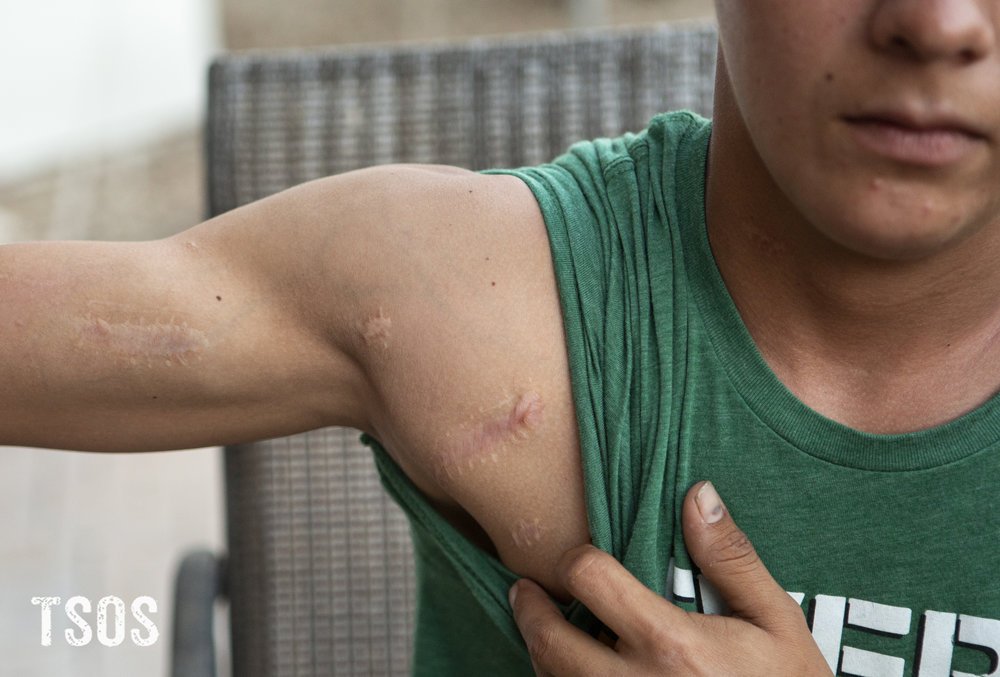
Eduardo shows some of the scars that remain after he was attacked by local gang members with machetes for not agreeing to sell drugs through his family’s fruit stand in Honduras. Photo provided by Their Story is Our Story.


Gang Violence

In the absence of any strong central government in Haiti, around 200 gangs have established influence across Haiti, including controlling an estimated 60% of Haiti’s capital, Port-au-Prince. These gangs have committed acts of physical and sexual violence. They have forced people out of their homes and blocked access to safe drinking water, food and health care. 

Gang violence is also endemic in places like El Salvador and Honduras. In 2019, in partnership with Their Story Is Our Story, we told you about Eduardo, who was attacked by gang members after he refused to sell drugs from his family’s fruit stand in Honduras. Fleeing often seems like the only option for people like Eduardo who are threatened, attacked, and even killed if they refuse to pay, join, or do the bidding of local gangs.

Economic Instability

Unsurprisingly, in places where governments are not stable, neither are economies. In Nicaragua and Venezuela, inflation, declining wages, and rampant unemployment have left people unable to support themselves and their families. Essentials like food, clothing, and medication are often in short supply.

An estimated 60% of Guatemalans live in poverty. This is partly due to a decade of “land grabs”. Small farmers in Guatemala have been driven off their land by more powerful people who want to develop their land into larger, industrial farms. Indigenous Mayan people living in the Guatemalan highlands have been particularly susceptible to these government-sanctioned “land grabs”. When targeted communities protest the seizure of their ancestral lands, leaders can be arrested or assassinated. 

Natural Disasters

Farmers in Guatemala have not only suffered from land grabs, but also from droughts, floods, hurricanes and cold snaps. Guatemala is not alone. According to this Washington Post article, Latin America and the Caribbean experienced 175 natural disasters between 2020 and 2022. These events have led to loss of life, damage to housing and infrastructure, crop damage and food shortages, and lack of access to clean water.


Pallets of aid on their way from the LHI Aid Warehouse in Utah to Team Brownsville in Texas.


How LHI Helps

LHI works in partnership with several shelters in places like Texas and Arizona to provide aid to refugees and asylum seekers. One partner, Team Brownsville, told us in December: “We are receiving up to 600 people every day and the need is so great…Our greatest need is for blankets,warm clothing and shoes. We quickly and gratefully gave out all the jackets, hoodies, winter kits, socks, underwear and shoes that you sent. We tried to hold back some for when it got even colder, but as the numbers grew, that became impossible.” Thanks to our donors and volunteers at the LHI Aid Warehouse in Utah, we were able to send more aid to Team Brownsville.

To learn more about LHI’s Border Aid program, click here.

News from Ukraine: An Apartment Complex in Dnipro Was Destroyed. LHI Was There.

by Brigid Rowlings, LHI Communications Director

This photo of an apartment complex that was hit by a Russian missile on Saturday, January 14 was taken by a partner on the ground who was there to distribute LHI aid to displaced residents.

On Monday morning, I opened my Slack messages to find that Serhii, LHI’s Ukraine country director, had sent video and pictures of an apartment complex in Dnipro that had been hit by a missile. I’ve always been a news junkie—something that now serves me well in my role as LHI communication director—so I’d been following Russia’s weekend attacks on Kyiv, Kharkiv, and Dnipro. But seeing the video and photos that Serhii sent along hit me so much harder and brought me so much closer to the reality of life in Ukraine right now.

According to the Associated Press, at least 29 civilians died as a result of the attack, and over 70 people were wounded. As of Monday morning, over 40 people were still missing. Of course, those numbers are staggering, especially since each represents one human life. The number that really stood out to me, however, was the number of people who had lived in the apartment complex—1,700—who were now homeless in the bitter Ukrainian winter.

What shook me further was reading in the Washington Post that Dnipro had been a refuge for displaced people from Russian-occupied Mariupol as well as Donetsk and Luhansk, areas on the front lines. I don’t know if any of the people who lived in the apartment building were people who’d fled Mariupol, Donetsk, or Luhansk. I do know that those people who had relocated to Dnipro in search of safety are now likely doing an impossible calculus as they try to figure out what to do next.


LHI arrived quickly to the emergency response station near the apartment complex in Dnipro. These boxes contain warm clothing, baby items, and personal care items—all things displaced residents lost.


It really hasn’t been easy immersing myself in all things Ukraine. I can’t imagine what it is like for my colleagues who live in Ukraine and neighboring Moldova or who visit Ukraine periodically to assess the needs on the ground. What keeps me going is knowing this work matters. When I see images of boxes of aid with the Lifting Hands International label sitting just yards away from the apartment building that was bombed, I know that telling all of you about the work that Lifting Hands International does matters. I want you to know that because of you, our supporters and volunteers, and the partnerships we’ve worked so hard to establish on the ground in Ukraine, almost overnight we had sleeping bags, socks, personal hygiene items, diapers and other essentials ready to distribute to the people who had lost everything. This is no small thing. 

Thank you for continuing to read the stories we share with you and to care about not only Ukrainian people, but all people who could use a lifting hand.

To learn more about our emergency response in Ukraine, click here.